

Illegal War
USA torpedoing the laws of war.
When the Iranian frigate IRIS Dena left India after participating in an international naval exercise, it continued its journey through the Indian Ocean. According to multiple reports, the vessel was not carrying live ammunition following the exercise. Shortly thereafter, however, it was torpedoed and sunk by a U.S. submarine in international waters.
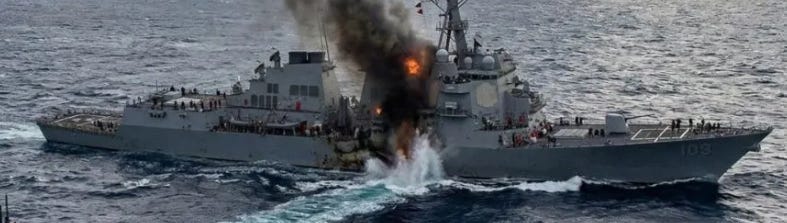
Approximately 180 people were believed to be on board. According to U.S. authorities, the incident marked the first time since World War II that a warship has been sunk by a torpedo in wartime.
U.S. Secretary of Defense Pete Hegseth described the event in terms that have themselves drawn strong reactions:
“In the Indian Ocean, an American submarine sunk an Iranian warship that thought it was safe in international waters. Instead, it was sunk by a torpedo. Quiet death. The first sinking of an enemy ship by a torpedo since World War II. Like in that war, back when we were still the War Department, we are fighting to win.”
The rhetoric aligns with a broader tone from U.S. leadership. President Donald Trump has also spoken about the bombing of Iranian targets, including Kharg Island off Iran’s coast, in triumphant terms, at one point even describing such actions as “fun” and “more enjoyable” than capturing enemy vessels.
At the same time, the attack on the Iranian vessel has triggered political controversy in India. Prime Minister Narendra Modi is facing criticism from commentators and opposition figures who suggest that India may have shared tracking data with the United States after the vessel left Indian jurisdiction. If true, this would raise serious questions about India’s role in a conflict to which it is not formally a party, and about the treatment of a ship that had participated in an exercise hosted by India itself.
Beyond the immediate geopolitical implications, the incident raises fundamental issues under the law of armed conflict.
International humanitarian law does not prohibit attacks on enemy warships as such, provided a state of armed conflict exists and the vessel is a legitimate military objective. However, even in war, conduct is not unregulated. The core principles of distinction, proportionality, and military necessity apply at all times. Attacks must be directed at lawful military targets, must not cause excessive incidental harm relative to the anticipated military advantage, and must be carried out in a manner that respects the limits imposed by international law.
Equally important are the rules governing those who are no longer taking part in hostilities. The obligation to offer quarter, meaning to spare or accept the surrender of an enemy who is hors de combat, is one of the oldest and most fundamental rules of warfare. It is codified in the Hague Regulations and reaffirmed in Additional Protocol I to the Geneva Conventions, and is widely regarded as customary international law. Even the U.S. military’s own doctrine explicitly states that it is “especially forbidden … to declare that no quarter will be given.”
This is not a technicality. The prohibition exists to prevent war from descending into annihilation. It draws a line between combat and extermination. When political and military leaders adopt language that frames the enemy not as combatants who may surrender, but as targets to be destroyed without exception, they move dangerously close to crossing that line.
The laws of war were developed precisely to prevent total war, to preserve a minimum of humanity even in the midst of armed conflict. They do not eliminate violence, but they seek to contain it.
For decades, the United States has presented itself as a guarantor of a “rules-based international order.” When its own leadership appears to erode those rules, it becomes increasingly difficult to ignore the implications.
For many countries in the Global South, however, this is not new. There has long been a perception that the rules are applied selectively, depending on who violates them and who suffers the consequences. What may be changing now is not the underlying reality, but the degree to which it is openly acknowledged.
Under Donald Trump, the rhetoric has become more direct and less filtered. What was once expressed in diplomatic language is now stated bluntly. For many observers around the world, this does not come as a revelation, but as confirmation.
In Europe, it has been easier to look away earlier. Not necessarily because the facts were different, but because alignment an d proximity made it more comfortable to do so. Europe was on the side of the bully, making the bullying easier to overlook.
the Devil IsRael states of america. The Antichrist.