

Apartheid
Palestinian hostages and a law that redefines justice in Israel
Israel’s parliament, the Knesset, has now passed a law allowing the death penalty for Palestinians convicted of carrying out deadly attacks.
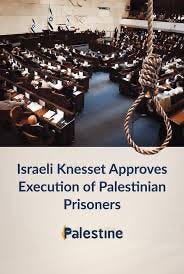
This marks a profound and deeply troubling shift.
Today, there are thousands of Palestinians in Israeli custody. Many have been held without charge or trial under administrative detention. Hundreds are children. Conditions in detention, especially for minors, have been heavily criticised by human rights organisations, including concerns about sanitation, access to food, and treatment during interrogation. Families often have little to no visibility into the legal process, and access to legal protections is limited.
These are, in reality, Palestinian hostages held within a system that operates under military rule. Calling them “prisoners”, as is often done, gives a sense of legitimacy that this system does not deserve.
The new law creates two distinct legal tracks. In Israeli civilian courts, judges may still choose between life imprisonment and a death sentence. But in military courts operating in the occupied West Bank, where only Palestinians are tried, the default becomes far harsher. There, the law introduces a presumption of the death penalty, with only limited room to reduce the sentence.
These military courts have long been criticised by human rights organisations for extremely high conviction rates and heavy reliance on confessions, often obtained under coercive conditions. At the same time, avenues for appeal under the new law are significantly restricted, and the traditional requirement for unanimous judicial agreement has been lowered.
The law was strongly promoted by far-right politicians, including Itamar Ben-Gvir, and supported by Prime Minister Benjamin Netanyahu and their allies.

Criticism has come from across the spectrum. Israeli opposition figures, legal experts, and human rights organisations have warned that the law is discriminatory and risks undermining fundamental legal principles. International actors have also reacted. The European Union has reiterated its opposition to the death penalty in all circumstances, and experts linked to the United Nations Human Rights Council have warned that such measures could violate the right to life and deepen unequal treatment under the law.
Supporters argue that harsher punishment is necessary in response to the October 7 attacks. But even within Israel, critics question whether this is about security, or politics. Because this is not only about the reintroduction of capital punishment. It is about who it applies to, and who it is applied against.
When thousands are already held as hostages within a system with limited legal safeguards, and a new law introduces execution as a potential outcome within that same system, something fundamental has shifted.

When one population is tried under civilian law, and another under military law, with fundamentally different standards, we are no longer looking at a system built on equal justice.
We are looking at a system where the value of life is weighed differently depending on who you are.
We are looking at apartheid, in its clearest form.
Utterly disgusting and abhorrent. Evil.
The Devil IsRael. The Antichrist.